Whoever Smelt it Dealt it: playground logic & the Hungarian elections
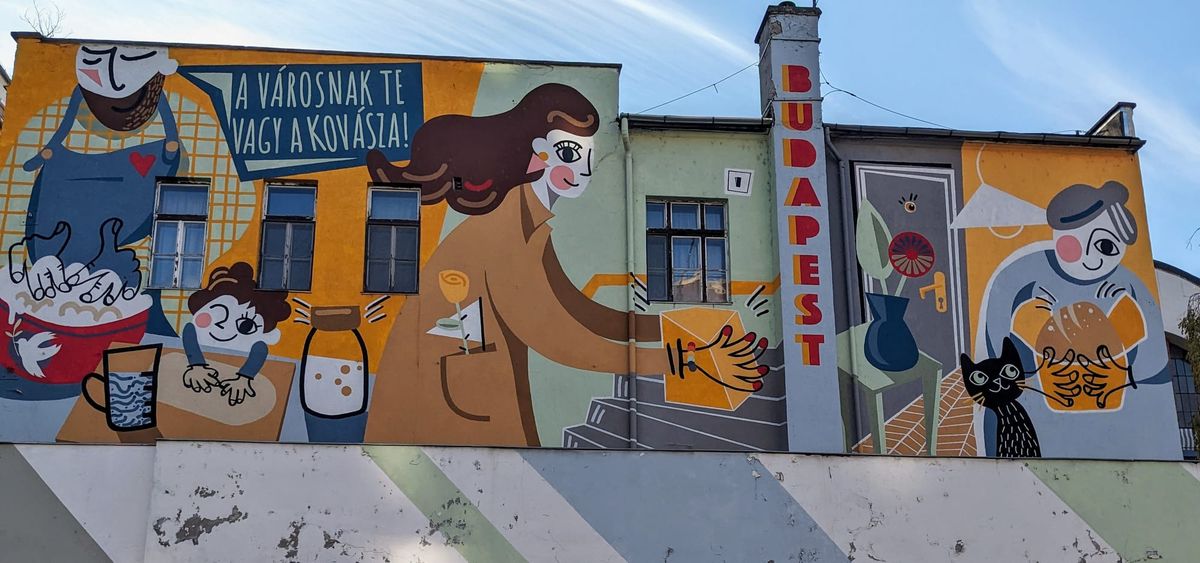
May we live in simplicated times.
This not ancient, not Chinese proverb is our curse to carry. We are not living in the upside down. The challenges of the moment are a mix of simple matters presented complexly, and complexities simplified through signifiers*, sorting, and sustained, stubbornly static notions in the face of accelerated change. Let’s be clear, this week is one of those moments that will register in the near and distant future to scholars studying our choices (even if the choices are a form of distracted abstention) and the consequences of those choices.
Hungarians go to the polls this weekend, and I am here to learn and play and consider and observe. On my path to Budapest (the standard route: Portland Sr to Detroit to London to Barçelona) I’ve seen more and more attention paid to this election. Yet I am also seeing and hearing very limited understanding, from those delivering the news and those following it. There is a plethora of excellent reporting to point people to. Unfortunately in an age where search is, erm, impaired, people are finding simplification and reductionism in those global media outlets that dominate what remains of discovery. So it is time to frame this in a simplicated way—and this takes us back to the middle school playground.
Whoever smelt it dealt it.
This phrase will ring naturally in the ears of Americans. ¿Do I need to explain it? I wish I didn’t need, to, yet here we are. My highly scientific surveys, aided by IA applications*, reveal that most people I know in New Europe are not familiar with the idiom/phrase. In short, someone passes gas (cuts the cheese, farts, toots, bum burps…what have you) and you are tempted to call it out, with the simple ¿who farted? The poor fool (not naming names here) who speaks up gets accused with “whoever smelt it dealt it.” ¿Huh? The science just doesn’t support this. And yet, perhaps now, in an accelerated world of absurdity. it offers us a way, a shortcut, to understand
I should clarify that it is spring in Hungary, and the smells are of food and coffee and flowers. Beautiful and inspiring. At the same time many things smell bad metaphorically.
There have been quite a few Americans here. With different objectives. Not just JD Vance. You may have seen his very public moment of embarrassment when his call go to his boss went straight to voice mail (though depending on the edit you might not have seen what Hungarians saw). Some key Putin allies have been here for weeks. So many elections observers, and "election observers” are here that I am waiting for a West Side Story style dance-off between the Sharks and the Jets.
Which brings us to Szabolcs Panyi. Szabolcs is a top investigative journalist, a prolific writer, and has a knack for framing issues to draw connections between his home country of Hungary, other Visegrad nations, Europe, and the world. He gives simple and honest paths into complicated news and information without being reductionist. He and his colleagues at VSquare.org and Direkt36 unveil intricate details of how the forces of authoritarianism and cynicism operate. And this is not the time to meet with Szabolcs (or for him to use up his time to meet with me).
Szabolcs's consistent and persistent investigations into the anti-democratic, anti-civic strategies and actions of Viktor Orbán, Orbánists, and their allies (home and abroad) have put him in danger. His recent work exposed direct contact between Hungary’s foreign minister, Péter Szijjártó, and his Kremlin counterpart, Sergei Lavrov. That these two were/are close was no big reveal here, or across Europe. The level of “chumminess” in the calls is nonetheless striking, as is the extent of the partnership in meting out what might simply be seen as Kremlin objectives like blocking sanctions efforts at the EU and getting people and banks off sanctions lists.
For this, Szabolcs is accused of spying “in coordination with a foreign country.” Let that sink in for a moment. He and his colleagues rigorously track and report on foreign interference, and get accused of espionage.
Whatever transpires this weekend in Hungary, news organizations can take a moment, get off the hamster wheel and consider where to put their resources and rethink their purpose. Think like a middle school boy, and take the accuser's finger pointing and, for a moment at least, direct it back at them. A thin accusation or lawsuit or criminal complaint against journalists, artists, and people working on behalf of vulnerable communities may reveal the actions of the powerful.
At the same time, the reader, the viewer, the listener—the curious global citizen—can’t wait for those of us in journalism to realize that the outdated constructs of our approach too often prevent us from committing the acts of journalism and sense-making the world needs. So when we see stories that simplify and sort in the name of efficiency, or that share a series of facts and details without a helpful framing, take a breath. Step away from the screen and think about something that gives you joy. Then remember that powerful leaders, with a history of fighting against transparency and inquiry, drive the news and rally emotions with broad accusations. Those very accusations may reveal what they have dealt.
Budapest is a dream of a city, and historically a city for dreamers. ¿What would Hollywood be without the Hungarians who launched studios ? ¿What would global football be without the Hungarians who took the game and moved it from English rigidity to beautiful controlled chaos? ¿AND what would Hungary be if those people had been able to stay in Hungary?
I don’t remember the last time when I saw so much strong reporting around an election—reporting that shies away from predictions and poll-watching to point to central local truths that reveal broad truths and uncertainties in this moment of accelerated change. You can catch up quickly on the complexities by tracking Szabolcs’s recent work here. And as long as you don’t ask me what I think will happen, or for any predictions, you are welcome to get in touch for more resources and details.
*Signifier: "a symbol, sound, or image (such as a word) that represents an underlying concept or meaning." Here I am referring to overused words that contain a variety of meanings for a variety of readers–conservative, liberal, left, etc–and therefore over-simplify and often present the opposite to a reader from what the writer is meaning to convey.
*IA: Intentionally Absurd